
Mosaic art
An art four thousand years in the making
Wherever people wanted endurance, strength and beauty, they built with stone. Our mosaics are 100% handmade from natural coloured stones gathered in different parts of Jordan.
Mosaic is one of the oldest decorative arts. It was used in ancient interiors to show images of cultural and spiritual meaning. The earliest mosaics date back some 4,000 years and were made of pebbles and cone-shaped pieces of terracotta, pressed into patterned backgrounds.
The art passed from the Greeks and Romans to the Byzantine Empire, and then through the Islamic dynasties: Umayyad, Abbasid, Fatimid, Mamluk and Ottoman. Along the way craftsmen began to use small cut pieces of stone, pottery and coloured glass, known as tesserae, on floors, walls and ceilings. Their work survives in churches, mosques, temples and houses from the Middle East to Europe, and gives a glimpse of how people lived.
Mosaics are still made by hand in almost the same way today, with sharper and more accurate tools.
The Jordanian technique
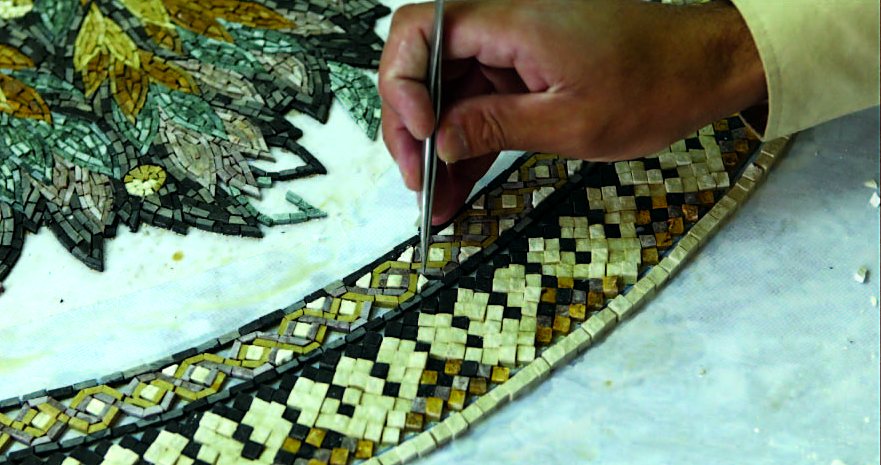
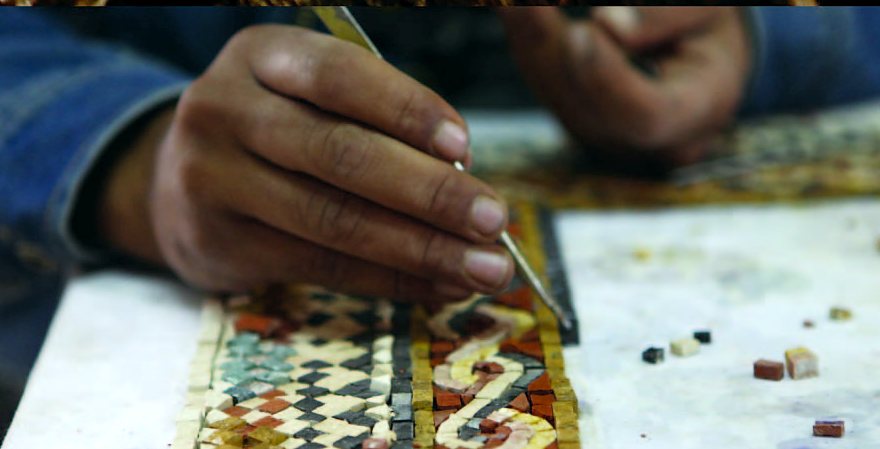
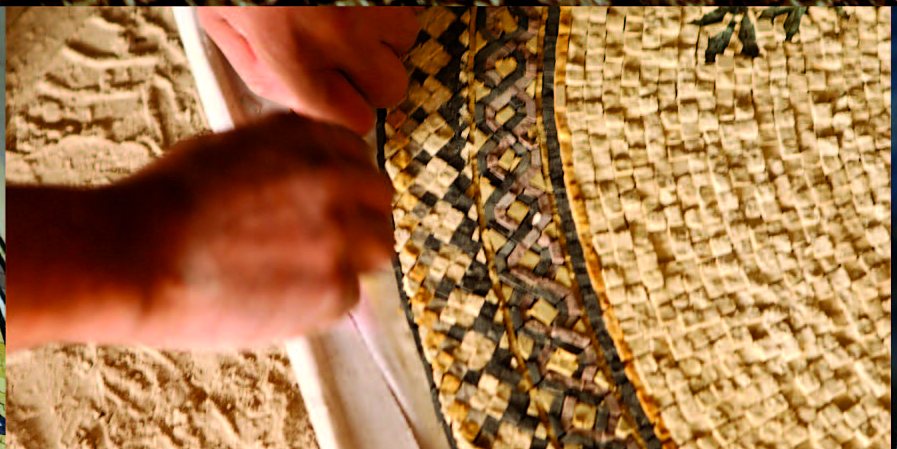
Natural coloured stones are cut into small pieces, either square or octagonal, and glued precisely onto a sketched design. When the design has dried, it is bonded into a cement block and left to harden naturally. A final coat of lacquer gives the finished piece its shine.
Greek and Roman mosaics
In Greek and Roman buildings a mosaic was a sign of wealth and standing. The subjects were scenes from history and everyday life, people honouring their gods, domestic themes, geometric designs and the twisted rope border known as guilloche. As the Roman Empire expanded, mosaics spread with it and the level of skill varied: those of Roman Britain are simpler in design and technique than those of Italy.
Islamic mosaics
Islamic mosaics reached Western Europe in the 8th century through the Iberian Peninsula. They are mainly geometric, in contrast to the figures of Byzantine art, and the mathematics behind their patterns is sophisticated. In the Arab world a distinctive style called zellij uses handmade ceramic shapes cut to fit together exactly, and the most intricate inlaid patterns are known as girih.
The Tree of Life mosaic of Jericho, from the Umayyad period, is counted among the most beautiful mosaics in the world. Its fruit tree, lion and gazelles reflect on the circle of life.